Friday, February 20, 2009

Living the Simple Life

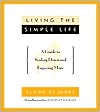
I read most of Elaine St. James' Living the Simple Life aloud to Smittywife while we were on vacation over Presidents' Day weekend; she has since been rereading it over the past week, in case you were wondering whether we thought it was a worthwhile read.

Simplifying--the Thoreauvian Imperative I like to call it--has been on our minds a lot recently, since the wedding and move certainly if not before that. We have too much stuff. We both would like to make better use of our leisure time (no wisecracks about my level of leisure time right now, please), and spend our money more wisely. Elaine St. James has written three books about the topic, and though they are more than a decade old now (and occasionally show their age) the tips and techniques she shares for finding more time in the day and overcoming our materialism and inability to keep our time scheduled the way we'd like are timeless.

It's worth pointing out here that Mrs. St. James and her husband are not sell-everything-and-move-to-a-cabin-in-the-woods people. They live in a condominium near a major city, and both work. They're not Unabomber freaks, anti-technology Luddites, or zero-carbon hippies. They're just normal people, living their lives more simply than most of us. And most of us, if we ever took the time to sit and think instead of filling every waking hour with activity, would agree a bit more simplicity would be a good thing. Smittywife and I agree wholeheartedly. We're always looking for help in the matter, and this book was very good for that. Enjoyably written, not particularly preachy. The only problem I have with it is that several parts of the book are clearly meant for people who are much, much busier and more stressed than we currently are. That's actually rather comforting, though.

I will admit, also, that over the last couple days as I've been unpacking the last of the book boxes, I've been able to put far books in the sell/donate pile than I would have thought possible before I read this book; reading about how another book freak managed to make the decision not to own every book in the world has been helpful. I recommend this book for anyone looking to simplify their own life (even parents), but if you don't at least partially buy into the notion that you may need to simplify, this won't convince you otherwise.

Wednesday, February 11, 2009

Patriots

A.J. Langguth's Patriots was published in 1989, and I've had it on my bookshelf almost that long (not really, but it's been at least five years). The great thing about history is that it really doesn't change much and a well-written popular history, barring new scholarship, is still going to be interesting 20 or 50 or 100 years after publishing. Patriots is well-written popular history.

Which is not say everyone will fall in love with it or that it's the greatest book ever on the subject. For starters not everyone enjoys reading history (I blame teachers for that. I have a theory that there is nothing inherent in anyone's personality that will make them like or dislike history; instead it's the teachers you have the first couple years you have to take history in school. Doesn't matter what age, whether you first take history in fourth grade or seventh grade. If at least one of your first two teachers makes history interesting you stand a chance, but if they both suck you'll never be able to get into it, no chance. Anyway), although this at least is fun history. Really, what American can't at least sorta get into a story about the Revolution?

Langguth frankly admits in the acknowledgements that Revolutionary history suffers from a lack of, shall we say, academic agreement on what actually happened. To some degree all the writer of history can do is pick the least unlikely of the available options. We know Washington didn't chop down a cherry tree; what we don't know beyond a shadow of a doubt is what he did do. At least he left a lot of letters.

I've read a bit about the Revolution. Founding Brothers was great. One of the things I liked about this was Langguth's decision to cover James Otis and Samuel Adams as heavily as he did. Unfortunately the focus on Massachussetts meant I kept wanting to know more about what was going in the South. I'm sure there's a book out there like that, but the thing is, going in, I had heard the name James Otis once, but knew nothing about him, and all I knew about Samuel Adams was that he was a brewer (it turns he was not, in fact, a brewer. He made malt, but never actually brewed beer; also, he didn't really make much malt, either, and was usually broke). Following them was great; I had no idea how important Samuel Adams actually was to the early movement for independence.

It's a really big book, about 600 pages. If that's not daunting it's worth your time.

Thursday, February 5, 2009

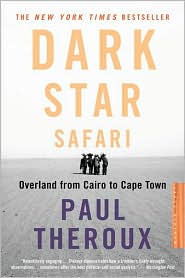
Dark Star Safari

This is the first time I've read Theroux. It will not be the last.

I think the sheer audacity of the trip Theroux proposes--from Cairo to Cape Town over land--is the most attractive aspect of the book, to me. I'd love to do something that foolhardy, that crazy, but I couldn't possibly leave my wife and family and go off to do that and not feel guilty about it every single day. Theroux has been doing it for decades.

After reading, what stays with me though is not just the fact of this absurd journey, but the imagery Theroux uses. I was completely taken with his writing, his use of the language, and throughout regardless of how I felt about his commentaries on various things the writing was just wonderful.

The trip is certainly worth taking. Theroux visits parts of Africa few Westerners ever visit, and does so via means rarely if ever taken by outsiders; I was reminded of Jeffery Tayler's canoe trip down the Congo when Theroux decided to take a boat downriver from Malawi into Mozambique; who does these things? I want to talk to these people; where do they get such a crazy notion and why is there no one around to talk them out of it?

The book, perhaps the traveller himself, is strongest when he is able to be with someone strong enough to strike up an actual relationship, however brief. In Ethiopia, Uganda, Malawi, and elsewhere Theroux spends several days with one person or a group of people and it is here that we get the best insight into Africans themselves; other conversations with former political prisoners--Theroux notes that a great many men of a certain age in Africa have been in prison, often for a fairly long time, a comment I'd heard in Djibouti but never considered--are equally illuminating. Theroux by himself tends to fall into a Brysonesque tendency to pick on people, though in fairness in Egypt he's picking on people who probably deserve it.

The book has received some press coverage and commentary for Theroux's strong comments about the international aid effort in Africa. Some of his complaints are petty and I think personal--he consistently complains that aid workers in their shiny new Land Rovers never stop to pick him up when he's looking for a ride; yet at the same time he knows full well how dangerous the areas he's going through are, and why should an aid worker believe his story and give him a ride when there are no doubt dozens of Africans who'd like the same favor? Theroux never considers that or, if he does, he doesn't write about it. Seems petty and I was a little annoyed with it by the sixth or seventh time he complained about it.

Theroux's main argument about aid is that the Aid For Africa industry--and it is an industry--has done nothing to improve the lives of everyday Africans, employs no Africans, involves no Africans in its decision-making, and works almost entirely to further the goals of other nations and the careers of the aid agencies themselves. Some of those criticisms are certainly fair, not the least of which is that all the millions or billions of dollars spent in Africa by aid agencies over the years has led to precisely zero improvement in the lives of Africans; things are indeed worse than ever. And a lot of aid programs are tied to requirements from the home country--the project must use a certain contractor or purchase materials from certain places, instead of everything being done in Africa by African suppliers and companies. Part of the reason there's no corporate infrastructure in Africa to speak of is that most government budgets are aid, and most aid requires projects to use international contractors, so local contractors can't even get work from their own governments and thus cannot build local wealth.

But a lot of aid work is done by Africans, and there is a glaring problem with Theroux's anti-aid bias: he never talks to an aid agency. He talks to a couple of Catholic nuns, and a handful of teachers, but not to anyone in a leadership capacity; indeed, he'd rather sneer at the people driving the Land Rovers than try to engage them, although in fairness they don't seem interested in engaging him.
There are people more learned than I about the topic who have criticized Theroux's statements, and I'll let you look those up if you're interested; a good bit of the criticism seems to be picking nits, though, and most impartial observers are coming to agree that there is something fundamentally wrong with the international aid is handled in Africa. Whether he's right in all the details, Theroux's complaints about aid are not unique and certainly should be food for thought.

Controversy aside, the book is a wonderful read, and there's just not anything else out there like it. Travel writing about Africa tends to be either limited in scope or of poor quality in general; this book is certainly neither of those. Now if there was just something of this quality about west Africa...

Wednesday, February 4, 2009

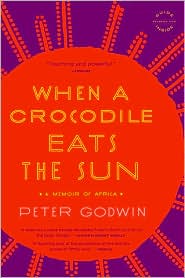
When a Crocodile Eats the Sun

I admit, I'll pick just about any book about Africa, and perhaps such books don't thrill the general audience (see, for example, A History of Post-Colonial Lusophone Africa). I don't really care. When a book is this good it doesn't matter. Peter Godwin's When a Crocodile Eats the Sun is without question the most deeply felt book I've read in a long time.

That does not mean it made me weep openly, or laugh out loud (certainly not that). When I picked it up, I was looking for something about the recent crisis in Zimbabwe, maybe some background on what might have changed in Robert Mugabe that he no longer about his country and only himself, and perhaps maybe a look inside the country at what it's like for the ordinary folks there. I was, I will admit, a bit disappointed that Mr. Godwin, whose picture appears on the back, is white. For shame, Smitty, for shame.

This is not a backgrounder on the crisis or even on the country, although Godwin includes good doses of history. This is a personal memoir, and, as those go, it is remarkable. During the years covered in this memoir, Mr. Godwin settled down and married and had children outside his home country, set up house in Manhattan, lived through 9/11, saw his mother become impoverished and his homeland destroyed, learned a long-held family secret and was forced to reconsider his own history, and lost his father. This was certainly an intensely emotional time, and writing about must have been difficult. Layered over these personal issues is the unyielding decline in his home, Zimbabwe, the country of his birth. Watching the rule of law dissolve in the place you grew up in and still cherish as home, watching the people there slide into poverty, crime, and open conflict, must be a terrible thing. To be able to do nothing about, that's even worse.

When I put the book down I was casting about for exactly what it was about it that made it so good. This is not like any other memoir I've read. It isn't just the combination of events Godwin relates, or his smooth writing style. There's something more, and I can't say exactly what it is. But after I'd thought about it, it occurred to me that at some level this book is simply filled with emotion, moreso than anything else I've read recently. The book just makes you feel. It's generally sad, but there are moments of joy and happiness. It is so well-crafted, though, it's not that reading the sad parts make you feel sad; it's that the full weight of the sadness Godwin feels is there, on the page, and instead of trying to manipulate your emotions he's simply writing his own. He's just doing it better than anyone I can remember reading. That's remarkable.

This is not always an easy book to read, but it is worth it. If you are interested in Zimbabwe at all, don't miss it.

Backlink

If you came here having read the previous note on Smitty's World about that blog shutting down, and were for some reason disappointed to read that... don't delete that bookmark just yet. The shutdown announcement may have been premature.

Tuesday, February 3, 2009

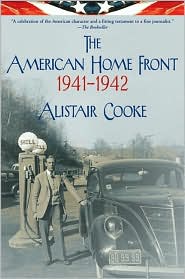
The American Home Front

This is one of many books I've had in the house for a while but never bothered to read. It's a shame I let it sit so long.

I have a number of books by people who've attempted to travel the entire breadth of the United States to... I don't know. Find America, usually. Sometimes there's a conceit--in the case of The Cannibal Queen, it was that the traveling was done in a 1941 Stearman biplane (my kind of conceit). In Lost Continent, the conceit was the in the author's attitude to everyone he came into contact with. In other cases, there's a specific reason driving the journey, as in Haynes Johnson's Divided We Fall, a tour of America during our last (real) recession in the early 1990s (a depressing but relevant book). I enjoy the genre, but I find that there's not usually anything terribly new in it from one book to the next, once you get past the conceit or the reason. You might go to a different place, but America is America, and as Bill Bryson pointed out just about everywhere has become Anytown USA.

That makes Alistair Cooke's The American Home Front: 1941-1942 rather interesting, as he made his journey before Levittown was built, and before the rest of the country started to look like it. Cooke was a Brit sent to America by the BBC to report on America to the British. He earned his citizenship in 1941, just before the war, and embarked on this journey primarily to give the good folks back home a look at America on the brink of war. The places he visits, even those that are intimately familiar (Jacksonville and Tampa, for example), are hardly recognizable, the America of Yesteryear, yet presented without nostalgia because the book was written in Yesteryear.

Needless to say I enjoyed it immensely, because I do like the genre. But like almost every book in said genre, it was a bit too long. America is very big. You can travel around America and notice things for about 200 pages before you need to wrap it up. Really. And you can't possibly see the whole country in that time, so you have to limit yourself... or not, as no one respects the 200-pages notion. So the books always drag by the last quarter. It's not that the writing isn't as good nor the insights as fresh, it's just that, well, nothing new is happening. Change in setting is not enough to maintain interest when everything else remains more or less the same. I can't think of a book I've read of this sort that wasn't too long; even On the Road was too long. It's a shame, because either you get sick of the book and the writer, or, as in this case, you're tempted to skim parts of the last quarter, and those areas of the country last on the itinerary you're less interested in reading about.

So. I like this genre, and anything well-written in it is going to be appealing. And the greatest fault of this book is the same as that for any other in the genre, namely, it runs a bit too long. Why read this one instead of any other? I could go on about Cooke's writing, which is very nice, or his observational abilities, which are excellent as one would hope for a journalist. The truth is, though, this is an America you can not go back to. And not only that, anyone today who tries to tell you what America was like in the 1940s, even from personal experience, is going to get a lot of things wrong. We are nostalgic creatures, and nostalgia colors our view of the past. You can't change that. The only way to get a sense of a historical place is to read a contemporary writer who was deliberately trying to write about the here and now. And that is exactly what Cooke was doing.

Some travel-across-America books do not wear well, for various reasons; the writing may be substandard, the conceit may hinder readers' interest. Others will still be read decades from now. I hope The American Home Front is in the latter category. It deserves an audience, and before long there will be few people left who can even offer clouded remembrances of the era. As a historical document then, as much as anything, this is a great book. How nice that it's also such an enjoyable read.

Tuesday, September 30, 2008

Six Short Book Reviews

I've been meaning to review these books forever and haven't got round to it and at this rate I won't for ages. So here's the abbreviated version in order of the first read. As always any of these are available for checkout from the Smitty Library.

1. An Embarrassment of Mangoes, by Ann Vanderhoof.
Wonderful book. Enjoyable to read, will whet your appetite for a Caribbean vacation. Great recipes, although we haven't actually tried any of them yet (but I really want to, especially now I know the DeKalb Farmer's Market in Atlanta has callaloo). Ann Vanderhoof has done what we all want to do--leave the rat race behind and take a vacation forever (or a year, in her case)--so obviously she has more money than the rest of us, but she never ever writes like it, and the book is just a pleasure. Highly recommended.

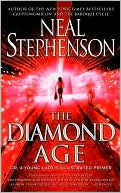
2. The Diamond Age, by Neal Stephenson.
A reread. I love Snow Crash and, the last time I read it, I still loved it. I like this book a great deal, but it runs out of steam 3/4 of the way through and enters a territory of great weirdness where it starts to get difficult to follow and even, frankly, to suspend disbelief for. Still contains wonderful moments of philosophy and lots of solid factual grounding, and still mostly a very fun read. But not as much fun as I remembered. Definitely worth looking at, but it shows the direction Stephenson has taken generally (i.e. increasingly hard to read).

3. Whatever You Do, Don't Run, by Peter Allison.
Subtitled "True Tales of a Botswana Safari Guide." Lots of fun. Not quite as funny as you might expect from the cover blurbs and actually surprisingly touching at times, nonetheless a light, quick read, perfect for a bedside book as it consists of a collection of short episodes. I greatly enjoyed this book, and I don't think you need to have gone on safari to enjoy it yourself. It may make you want to pick up and go, though. I suspect Mr. Allison has three or four more books of stories in him and he is a fine storyteller. Smittywife needs to read this before it goes into the lending library circulation.

4. Airline/Transport Pilot Oral Exam Guide
Technical book of very limited interest. Will be out of date soon anyway, and since none of the airlines are actually hiring I won't need to take the test. Useful for brushing up on things before my interview, though.

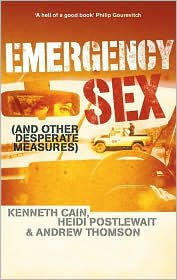
5. Emergency Sex, by Kenneth Cain, Heidi Postlewait, and Andrew Thomson.
Absolutely my highest recommendation; the best book I've read this year. The authors were UN Peacekeepers during the 1990s and into the early 2000s and these are their tales. If you are at all aware of the existence of other countries you should read this book. If you are a firebreathing conservative and think the UN should be shut down, you should read this book. If you are bleeding-heart liberal and think the UN should take over the world, you should read this book. If you think it matters at all how the US is viewed in the other countries, you should read this book. If you don't think it matters how the US is viewed in other countries but are aware that other people have opinions, you should read this book.
You should read this book. It is gripping. It is well-written. It matters.

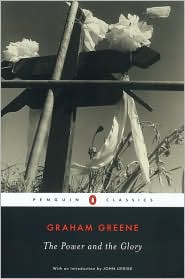
6. The Power and the Glory, by Graham Greene.
Interesting. On a lot of "Best Books" lists, which is why I read it. I will pick up The Quiet American and The Comedians on the basis of this, but I can't say I was exactly swept up in it or transfixed by its brilliance. Greene knows how to build a novel and is a good writer; if the subject matter, faith (in particular Catholicism) and keeping faith when there is no Earthly reason to do so, is of remote interest to you, this is one of few novels on the subject that doesn't preach to you (there's plenty of preachy junk out there for you if you want that). But it never really answers any questions, for the protagonist or for the reader. Valuable, but not one you need to put at the top of your list.

Thursday, July 24, 2008

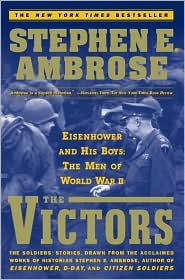
The Victors

Over the last week I slogged through The Victors, by Stephen E. Ambrose. Slogged is the wrong word, though, because it was actually a good read. Not always easy. Books about war never are. I could write thousands of words about this book. I think we're in danger of forgetting what it used to mean that we lived in America, what it was that differentiated this place from others. I can't see the spirit of World War II in our present conflicts; maybe it's because of our distinctly unenlightened leadership. Whatever it is, reading this book makes clear the difference in time frames; when we went out to fight an evil enemy in WWII, the nation as a whole sacrificed, especially those who went to fight. When we set out to fight the present evil enemy... the nation as a whole was told to go shopping. A sort of review follows the jump.

Maybe I'm just crotchety. I don't care. If we were actually in a fight as big our political leaders say it is, I think we'd be doing more than we are as a country. Anyway, I've gotten off topic. Ambrose was cited late in his life for shoddy research and plagiarism, and the proof is there if you wish to see it. He did skimp sometimes on research, and he did plagiarize (and although he never characterized it as such, most serious researchers would). But he still wrote a pretty readable book, and whatever his deficiencies in research, he is responsible for taking down the oral histories of hundreds, literally hundreds if not thousands, of WWII combat veterans, work that would likely never have been done otherwise. This book is in part the fruit of that particular labor, and whatever concerns may exist about plagiarism and such should be levelled at the man and not at the valuable work of recording history that he did.

Citizen Soldiers, the book from which much of this one is cribbed (his own book this time), would be a better in-depth look at the fighting man of WWII, but this book is a great overview. It is in fact one of the best examinations of life for the soldiers of WWII I've seen, certainly the best I've read. If you haven't read any of Ambrose's other works, and if you can get past the man's faults as a writer, it's a very good read.

Wednesday, July 23, 2008

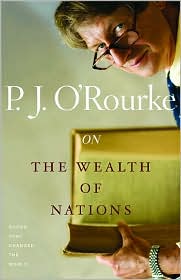
On The Wealth of Nations

I've been reading a bit lately. Good thing, too. There are a lot of good books out there and at the pace I've been reading this year I'm not going to get read them all (or even very many). Most recently I managed to pick up and finish P.J. O'Rourke's On The Wealth of Nations inside of a week. Woo-hoo! It helps that it's a bit short, and that P.J. is one of the most readable writers working today.

This book is part of the "Books That Changed the World" series published by Atlantic; other titles so far given the same treatment (by different authors) include Darwin's The Origin of Species, Marx's Das Kapital, and the Quran, and more are planned for Thomas Paine's The Rights of Man, Clausewitz' On War, the Bible, and others. It's an interesting series, and let's go ahead and admit right now that we're not going to read any of these books cover-to-cover in our lifetimes, at least not likely. (Exceptions are made for the Bible and the Quran for people adhering to the relevant faiths, although I'll wager many a Christian goes to his grave never having made it through Isaiah or 2 Chronicles.) On that truth rests the basis for this series (a series that, when I described it to Smittywife, prompted the response, "Who's doing War and Peace," a fair question and one that I wonder whether Atlantic has considered). I have a modest review after the jump.
I actually do own Adam Smith's An Inquiry into the Nature and Causes of the Wealth of Nations, and I even brought it with me on a deployment once on the theory that there is so much downtime on deployments that I might actually read the thing. There is a lot of downtime, but there are a dozen easier ways to kill it than with 900 pages of 18th Century philosophy. Since I haven't read it, P.J. read it for me. I should send a thank you note.

So... do I review this book, or the book that this book is about? Tough to say. The book itself is a quick read, surprisingly light considering the weight of its subject. O'Rourke, I hate to say it, may not have been the best choice for this particular review because he comes to the table with, shall we say, some pretty strong political and economic ideas of his own; he did write a book called Eat the Rich, after all. But sometimes having a slightly biased reviewer is good, as P.J. is willing to recognize when Adam Smith had a failure of imagination (or of wisdom), something which happens to most philosophers.

I could happily sit and discuss some of Smith's precepts, and perhaps I shall, but in another post. This is a book review, and I must say that this is a book that you probably should read, and which thankfully you will also enjoy. Not many things are like that. I know you're not going to read The Wealth of Nations, and you know it, too. But it is a very important work, and rests at the foundation of our entire society. And it is deeply misunderstood, too--just for starters, the whole "invisible hand" thing, Smith himself used the phrase only twice and one of those was sarcasm. But you have to dig into the 900-page tome to figure that out. And who has the time? P.J. was getting paid to read the thing, at least, and his discussion of it is readable, intelligent, and sometimes even fun. Heck, certainly you can devote a couple of weeks' reading time to one of the most important works in modern philosophy, right? I recommend it.

Saturday, July 19, 2008

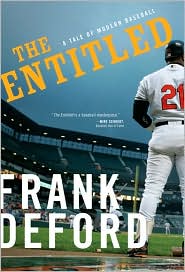
The Entitled

I picked up Frank DeFord's The Entitled a few weeks ago on sale at Borders, and decided I'd read it now, during the season, rather than wait until next year or whatever. Kind of a lark, really.

Dang is this a good book. It's subtitled as "A Tale of Modern Baseball," and the cover blurb says it "ranks with the greatest sports novels ever written." "Sports novels" are not a genre I've read much of, although I did read The Natural in college. But I won't dispute the cover blurb, and the truth is, this is waaaay more than a baseball book.

I'll keep this review short because, really, I think you should read this. I think you should definitely pick this book up at the library or the bookstore and give it a week, because that's all it's going to take (heck, it took me barely a week and I've been reading at my slowest pace in years). It draws you in, and although the first half of it will appeal to any even casual baseball fan (DeFord knows the game, knows the players and the managers and not for a second do you ever doubt the veracity of Howie Traveler as the veteran manager or Jay Alcazar as the gifted star), by the time I was into the middle of the book I was so drawn to the characters the book could have been about professional housepainters and it wouldn't have mattered. This isn't just a great sports novel, it's a great novel, period, and the issues it raises are really far deeper than you'd ever expect.

The Entitled gets my highest recommendation.

Sunday, July 13, 2008

Buddha Is as Buddha Does

I have finished Buddha Is as Buddha Does, by Lama Surya Das. I don't know what to say about it. I started reading this nearly three months ago, and a book this long of this nature should not take so long to read. Especially considering as I enjoyed reading it.

It is not a book meant to be read quickly. It is to be considered, studied, pondered, meditated over (I didn't do enough of that last). It became frustrating toward the end as the teachings in it began to diverge significantly from my own rational beliefs--and yet even as it did so Lama Surya Das brought me back into it by acknowledging the metaphorical nature of much spiritual writing and belief. Who is to say that things we did not see ourselves are literally true? Ah, but isn't there a lesson even if such things are merely meant as metaphors?

Indeed. I will return to this book again, many times perhaps. But it remains a challenging text. I think I'll pick something easy for the next one.

Friday, July 11, 2008

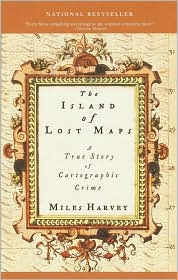
The Island of Lost Maps

Recently I finished The Island of Lost Maps by Miles Harvey. It was a pretty good read, especially so for a map geek like me. A brief review follows the jump.

I enjoyed the book, but it is a weird little tome. You may or may not have heard about the crime spree that inspired it--odds are you didn't, since I think the only major news outlet that covered it was NPR and I listen to NPR all the time. Of course this was back in the late 1990s.

Nonetheless, it's a strange subject for a book--and indeed, the book's subject seems to drift around a lot. Is it about old maps? Map-collecting and map collectors? Gilbert Bland (the thief in question)? Or is it about Mr. Harvey's search for Gilbert Bland? Really, it's all of those things, and that could be leveled as criticism against the book, if you were inclined to do so. I won't.

The book can be fascinating at times. Harvey's descriptions of the Peabody Library in Baltimore, of Bland's crime there, his dealings with the map trader Graham Arader, are all fascinating reading, and great writing. Harvey is generally at his best when treading historical waters here and those passages are always interesting.

The book is a quick read until about the last third, when things begin to slow down a great deal as we focus less on Mr. Bland and the history of cartography and more on Mr. Harvey and his research for the book. As he starts soul-searching about what exactly it is he's doing, we start asking ourselves the same question, and that's never a good idea in a book. I shouldn't be wondering why you're bothering to write this--and if you're not sure yourself, you certainly shouldn't tell me.

Fortunately it all picked up a little at the very end, just before the epilogue, and on the whole it's certainly an interesting read. Harvey's writing on the nature of map geeks and what it means for us to stare at a map and be absorbed by it for hours is the most eloquent writing on the subject I've ever seen. Well worth the time.