Sunday, August 26, 2007

Absurdistan

I actually finished Gary Shteyngart's Absurdistan two weeks ago, but I've had to cogitate over whether or not I really liked it in order to write an actual review.
Let me start out by saying, I liked it well enough. But I didn't always find it easy.

I won't claim the book has any great flaws. From a literary perspective I'm not qualified to claim that and, anyway, I don't have any nits to pick. Instead there were just so many little things that occasionally put me off. For example, the country for which the book is named, Absurdistan, doesn't appear in the book until almost halfway through. The author shows up and makes fun of himself for writing this book. The protagonist is... shall we say, he's not terribly easy to accomodate.

To wit, Absurdistan introduces us to Misha Vainberg, a Russian Jew, the son of a mid-level Russian gangster, a man of large appetites and the wherewithal to feed them. He is not easy for any of us to recognize. He is tremendously overweight, suffers from anxiety and depression, and does not work. He is in love with New York but cannot go there because of things his father the gangster did to Americans in the past. He is in love with a poor girl from the Bronx he met at a Coyote Ugly-type bar. What she sees in him, apart from money, I can never really understand, because to be honest, Misha is not, for the first half of the book, all that likable.

In fairness, as Misha himself explains, he is a Russian, not an American, so if Americans think some of the things he does are unusual... bah! In Russia it is acceptable to throw your shoes at your servants. (That he has servants sets him several levels above most of us who'll be reading about him.)

Misha also idolizes his father in ways that don't always seem healthy. To be honest at times I found myself wondering whether Misha was dancing around the fact that his father sexually abused him. It seems like it would fit. He never comes clean. He doesn't, to be honest, say much about his father, apart from occasional sermons on how much he misses and loved his father. That's all. There's a very weird vibe there, and I don't usually look for those sorts of things.

The first half of the book keeps Misha in Russia, a place he seems to want to leave but only for America--the one place he cannot go. He is miserable and does dreadful things. He is not, in short, easy to like, easy to care about, easy to really stay interested in.

This is not to say that protagonists have to be likable or good people or any of that rot. I would not wish to argue that. But, likable or not, I need a reason to care about what the protagonist is up to and why I'm bothering to read a story about him. This can work with unlikable people just fine, and is more fun with flawed people--and Misha is these things. But he's not... I don't know, I just couldn't get around to where I really cared about him. He's a difficult character. Shteyngart has won a lot of praise for this book, though, so perhaps I'm missing something.

Once we move from St. Petersburg to Absurdistan, however, things pick up. Yes, the action picks up, which is helpful, but what matters is that Misha picks up as a character, too. For half the book he talks about how he's really a decent person and wants to help, but he doesn't do much of it. Then, as he's on his way to Absurdistan, he finally takes action to demonstrate what he's been claiming--and, once in Absurdistan and when things start to go awry, he demonstrates at least some mettle, and finally I could really identify with him. He wasn't just all talk, he was actually going to try to do something. Nice. Took too long to get there.

Thus the book does reward your patience. Shteyngart does a good job of describing one of these post-Soviet countries where you live and die by the favor of the government and half the budget is made up of U.S. grants. Sort of like Kyrgyzstan, really. Absurdistan has been colonized by KBR--Kellogg, Brown & Root, a former division of Halliburton--and Shteyngart's description of how KBR works is... well, it's dead on accurate, which is pretty scary.

In any event the latter half of the book is well worth the first half, and since I still can't put my finger on exactly why I didn't care for the first half so much... well, maybe you'll like it better than I did. I don't know. But there was one character who so consistently irritated me I can't leave without a mention.

Professor Jerry Shteynfarb. Note the shocking resemblance to the author's own name. Indeed, this is... well, clearly Shteynfarb takes a great deal of his character from the author. Shteynfarb/gart both left Russia at the age of 7 and are American citizens, both teach in New York, both have written books that won them praise. Indeed, Shteyngart seems to have anticipated some of the reviews he'd get--one dust-jacket blurb notes that "No one is more capable of dealing with [the subject] than Shteyngart..." which Misha pointedly argues (persuasively, I might add) is hardly the case. Shteynfarb lets Shteyngart make fun of Shteyngart... but, really, do we need that? The criticism there, of the way a man who left Russia at 7 is treated as the great relater of Russian-ness to the West, that's valid. But is this the tool to use to make the criticism? Makes his reviewers, if not all of his readers, seem a bit daft to me. I don't buy it. Shteyngart's next book supposedly has Shteynfarb as the protagonist. I've been guilty of writing a book where the protagonist is based on me, and I think now I understand better why I never really warmed up to it as much as I thought I would. That book still needs a lot of work, and I probably won't be buying Shteyngart's next one. Take it for what you will.

Harry Potter and the Deathly Hallows

I finished it, at last. This is about the longest it's taken me to read a Harry Potter book. But I'm busy.

Obviously I can't give anything away because you might not have read it. But... well, okay, I know Rambling has finished it. And I know Scanime and Mrs. Scanime were reading it, but I don't know if they've both finished it. And I don't know whether the fabulous Mrs. G has had time to read it what with raising the little ones and all. Anybody else? Who else has finished it? I want to talk!

Okay. By way of a review: I liked it. It was certainly gripping. It had the slow patch I've come to expect from Mrs. Rowling but that was less noticeable this time and more broken up. The ending was... it was good. The last three chapters, say, or four, four chapters, very very good. The Epilogue quite nicely put things together without giving unnecessary details, so we are free to fill in the gaps as we wish ourselves. I will note here that my assertion in my review of the previous book that "I now believe nearly the entire story arc of book 7 can be found in the six existing books" was perhaps innaccurate. I'll have to reread the others again with an eye to the Deathly Hallows themselves.

Also, I'd like to note that Severus Snape met my expectations.

There, I don't think I've given anything away.

Monday, August 20, 2007

A Name Selected

Thank you all! Based on suggestions--Attenborough was particularly good--I have decided on Overbury. Probably Ted Overbury, not sure. The Life of Sir Thomas Overbury may give you some inclination of the direction this character is headed...

Sunday, August 19, 2007

Name Suggestions Needed

I'm looking for a 4-syllable surname that sounds English. Or, if not English, at least not blatantly ethno-specific: no Takahashis, no DiSalvatores, no Hackensteiners. The only thing I've come up with is Neverwinter, which I like, but is not a surname anywhere I can find. All suggestions welcome and appreciated.

Saturday, July 21, 2007

Set Phasers on Stun

I borrowed Steven Casey's Set Phasers on Stun from Lucky Bob because it sounded interesting and Lucky wrote a good review. I did the borrowing back in... oh, December. Really. It's been on the sidebar a long time, huh?

Well, I made the mistake of setting the book by the bed as a little before-bed reading. Unfortunately, though it's interesting, it gave me kafka dreams if I read it right before bed. I mean, the whole book is about situations where there was a small error in engineering--generally, where a product was designed without the end-user in mind--and sadly most of these ended in tragedy, one life or many. Not the best bedside reading.

So I read almost all of it in the last couple weeks not at bedtime, and it was much better. It's a very interesting book, and I can see why it was a textbook for an engineering design class. Now I just have to figure out how to get it back to its rightful owner.

Thursday, July 12, 2007

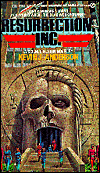
Resurrection, Inc.

Smittygirl's best friend recommended this book to me, and although it's not normally my genre I always like reading other peoples' favorite books (and I'll lend anybody copies of my favorite books if they want). The book is out of print now but if you click on the cover you'll be taken to BN.com's used book area. At least that's what supposed to happen. Anyway, on to the review!
Having just read Fierce Invalids, I caught something interesting in this book that I might not have picked up on otherwise.

Switters, our fearless hero from Fierce Invalids, has this idea that government and industry combine to keep the great mass of people entertained by meaningless garbage--Jessica Simpson, movie box office totals, the latest tawdry Hollywood affair, sports stars using steroids, even politics presented purely as a horse race--because it keeps them from getting curious about anything else, keeps them too happily occupied to ask questions about what the government or corporations are doing. Thus they can do what they want without much inquiry from thinking people.

The antihero of Resurrection, Inc., Francois Nathans, believes he is setting humanity free by creating undead Servants to fill menial tasks--and finds out that the majority of people set free in such a manner are bored, incurious about government or industry or, indeed, anything at all. Nathans had hoped they would take up the arts, sciences, anything--give in to natural human curiousity. Instead, they didn't--and Nathans sets out to eliminate them once and for all.

What an interesting perspective. Is Switters right, that without constant entertainment people would actually ask questions about the world around them? I like to think he is--curiosity and a desire to learn are hallmarks of humanity. But what if Kevin Anderson, the author of Resurrection, Inc., is right? What if, deprived not only of constant entertainment but of menial work, many people would just sit bored, turn to crime or riots not out of a need to support themselves but simply because they can't think of anything else to do?

One of the books on my reading list is Down and Out in the Magic Kingdom, one of many futurist books set in a post-scarcity world, where the only things that are hard to come by are good seats in restaurants and short lines at theme parks. Post-scarcity worlds have been treated before by science fiction writers (see the Culture cycle by Iain Banks, the Queendom of Sol by Wil McCarthy, and E.M. Forster's The Machine Stops or Arthur C. Clarke's The City and the Stars, though I haven't read any of these; even The Matrix is a sort of post-scarcity society, at least for the machines that control the place), and occasionally there are looks at the world as it struggles to get to that post-scarcity plain. The Diamond Age by Neal Stephenson shows a society approaching post-scarcity. And Resurrection, Inc. shows one man's attempt to push society in that direction.

Writers are divided on whether post-scarcity is good or not (in Riders of the Purple Wage, Philip Jose Farmer notes that artists, though they are the toast of society, often run out of inspiration for their art because the society is free of conflict). Francois Nathans seems to have believed it would be great. Though his Servant revolution (Servants are recently deceased people who's bodies are preserved and implanted with microprocessors and synthetic fluids to allow to function as androids would--except androids are prohibitively expensive and there's an endless supply of the dead) would not have ushered in true post-scarcity economics, he did create the means for vast improvements in efficiency in most industries and commerce, meaning many people lost their jobs but were supported by bouyant governments and welfare (presumably in turn supported by immensely more profitable industry). Nathans and his company (Resurrection, Inc., of course) might have started the machinery of the post-scarcity age to come.

But what happens when nothing is scarce and thus no one needs to work? In Resurrection, Inc., we see that a lot of people don't even bother to get up in the morning. A version of online gaming (the book was written in 1988 so MUDs existed at the time, but Anderson still made a good guess at where multiplayer online games were headed) occupies many people, and others simply sit around, bored, start riots, or turn to petty crime. In the world of Resurrection, Inc., scarcity matters--without it, people's live become meaningless.

I suppose this is the danger of defining yourself through your work--when you have no work, you have no self-definition, either. Though I doubt that was Anderson's goal in telling this story.

Indeed, this is a pretty ripping yarn all the way through, and I haven't even mentioned any of the main plot points. Bear in mind I referred to Francois Nathans as the antihero--because he's certainly no hero. After all, as wonderful as Servants may be, even if the people they freed from work found constructive things to do, everything wouldn't be quite hunky-dory, now would it? What if, through a quirk of the resurrection process, some Servants retained the memories of their previous life... and death?

Oh what a tangled web we weave.

Good book. You'll probably find it a well-stocked local library.

Wednesday, July 4, 2007

Fierce Invalids Home From Hot Climates

Verbose, aimless, disorganized, overstuffed, and incredibly delightful. There's just so much going on in Tom Robbins' Fierce Invalids Home From Hot Climates it's impossible not to like it. My review follows the jump.

If I wanted to, of course, I could find plenty of things wrong with it. Robbins just loves his big words, almost abuses vocabulary. And with a lot of other authors (myself included, probably), that just gets annoying. Here it's generally a pleasure, only occasionally a bother. The book seems barely contained, asides and tangents spring up amid the fertile soil of Robbins' pen and wither on the ground, leaving the reader lost in the garden and desperately trying to catch up. Again, this sort of thing could be annoying, but here... here, it's not.

I've never read Tom Robbins before. I think his best-known work would be Even Cowgirls Get The Blues, which was made into a movie a few years ago. But that book is from another era; Fierce Invalids was written in the late 90's and the world of its main character is clearly recognizable. I had a great time and I'm going to go out looking for his most recent novel, Villa Incognito, but that doesn't mean I'd recommend this book to everyone.

Robbins breaks the fourth wall. He does so in the fourth chapter quite blatantly, and occasionally throughout, though most noticeably (and, I'm afraid, distractingly), right towards the end, and the beginning of Part 4. The book veers dangerously close, at times, to polemic, as Robbins (through his character and mouthpiece, Switters) decries the state of everything, from American society (controlled by a government and corporations that want everyone kept dimwitted and incurious) and foreign policy to organized religion and the nature of life itself.

This could get tedious if readers aren't receptive to this sort of thing. If, for example, you would be offended by Switters' assertion late in the book that "terrorism is the only rational response to American foreign policy," there will be plenty of other things in here you will be so annoyed by that you won't enjoy the book. If, on the other hand, you could care less what Switters thinks about foreign policy (being a fictional character, after all), or you agree with him, then you'll enjoy it.

There's no question but that Robbins' phrases are wonderful. In this one book you'll come across so many fascinating new metaphors you'll wonder why anyone ever resorts to cliche (well, not everyone is blessed with so fecund a mind as Mr. Robbins). Read it for the words, for the joy of reading, as much as anything.

But it's actually about something, too. And that's where it gets fun. Our hero, Switters, is a man of contrast, of inner contradictions--as, says Robbins, are we all. But unlike most of us, Switters is not concerned about taking one side in his inner life. He takes both. He loves his 16-year-old virgin stepsister, and a 46-year-old nun at the same time. And even to the last page he's trying to figure out how to have them both. Switters' message to is to embrace our inner contradictions, for to do otherwise is a betrayal of both our beliefs and ourselves. At one point he points out that being willing to lie to protect a belief is just one step away from being willing to kill for the same purpose. And much, if not all, of the world's suffering has stemmed from that very evil. Better to embrace our own inner contradictions first, thus be ready to accept the contradictions thrust upon us and our beliefs by the outside world.

All this is somewhat lost in the mysterious coda, however. The last several paragraphs take Switters to Thailand, and while I don't suppose they detract from Switters' character or our understanding, I don't see how they add anything to the story. Oh well. Nothing, and no one, is perfect.

Saturday, June 23, 2007

2005 Books

This is a list of all the books I read after about May of 2005. Click on a cover, and you'll be taken to my review. Click on the cover in the review, and you'll be taken to Barnes & Noble if you want to buy the book. Or at least see how much money I spent on it...

2006 Books

This is a list of all the books I read in 2006 other than in Djibouti. Click on a cover, and you'll be taken to my review. Click on the cover in the review, and you'll be taken to Barnes & Noble if you want to buy the book. Or at least see how much money I spent on it...

Djibouti Books

This is a list of all the books I read in Djibouti in 2006. Click on a cover, and you'll be taken to my review. Click on the cover in the review, and you'll be taken to Barnes & Noble if you want to buy the book. Or at least see how much money I spent on it...